
The methodology of discovery is a preliminary phase in the UX design process to ensure that the solution being built addresses a genuine and useful need, i.e., this approach helps UX professionals to understand whether they are wrongly making assumptions concerning the users’ needs.
The discovery process involves interviewing and surveying users to document their current problems and exploring them before focusing on the solution, enabling the team to develop more valuable tools that meet clients’ and end-users needs.
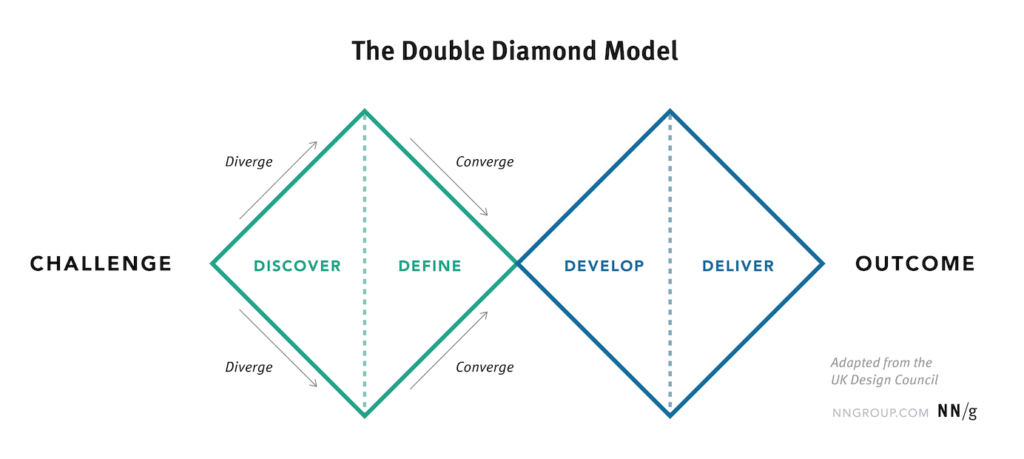
As illustrated in the double-diamond model introduced by the UK Design Council, the discovery process begins with a divergent (discover-define) phase, in which the team opens up to many ideas while focusing on figuring out the problem and all of its variables. Once this knowledge is in the team’s hands, they can move on to the next stage of convergence (develop-deliver) demonstrated in the second diamond, in which the purpose is to develop an actual design solution that fits the discoveries made in the first diamond.
But how long is the Discovery?
The better the research context is evaluated, the easier it is to estimate the length of the discovery process. Still, the truth is that there is not an exact timeframe for the Discovery since it depends on several variables.
Firstly, the problem and the number of existing root causes should be considered because the larger the number of affected users, the more extensive the research. Also, the scale of the existing service is a key aspect that requires analysis to prioritize the route that makes the most sense for creating a solution and not focusing on areas that may not be as relevant to the user.
Further, the professionals working on the project should assess how much they already know about the users, their pains, and why and how the problem occurs.
With that knowledge well established, the discovery process can flow more smoothly so that the team can compile the relevant data and move on to the solution stage.
Nevertheless, designers often use a few approaches to estimate the length of the discovery process, but the one that tends to generate more results is the forced timebox.
Forced timebox: It is a powerful time management tool that means setting a timeframe for the Discovery and gathering as much information as possible in this period. It prevents the Discovery from dragging on longer than necessary.
However, it is fundamental to emphasize that the choice for any strategy will depend on the variables mentioned above and the profile of the team working on the project since this is not a one-person job. It is essential to ensure the collaboration of all those involved in developing the solution, ranging from UX designers to stakeholders, to get a clear and shared vision of the objectives to be met.
How important is the discovery process?
As previously mentioned, the discovery process requires the cooperation of the whole team involved in the design, including the client, to understand the product completely. Besides structuring a good development plan, a collaborative effort leads to a higher possibility of success for the product.
Therefore, prioritizing the discovery process lies in mitigating risks, as it allows a clear definition of all opportunities that generate value for the client and users. It is much more expensive to modify a product already available to the public than to adjust all the variables beforehand and present something viable in the market.
References:
Lawrence, N. (2021, November 17). UX/UI Design: Effective Time-boxing. UXPlanet. https://uxplanet.org/ui-ux-design-effective-time-boxing-e58a6e8c458b
Paliychuk, U. (2022, February 22). Why UX Design Discovery is Essential for a Project Success and How we Approach it. Beetroot. https://beetroot.co/business/why-ux-design-discovery-is-essential-for-a-project-success-and-how-we-approach-it/
Rosala, M. (2020, March 15). The Discovery Phase in UX Projects (UX). Nielsen Norman Group. https://www.nngroup.com/articles/discovery-phase/
If you enjoyed the content, stay tuned for the following posts, and if you want to get in touch with me or know more about my work, check out my Homepage and hit me up!
Leave a Reply