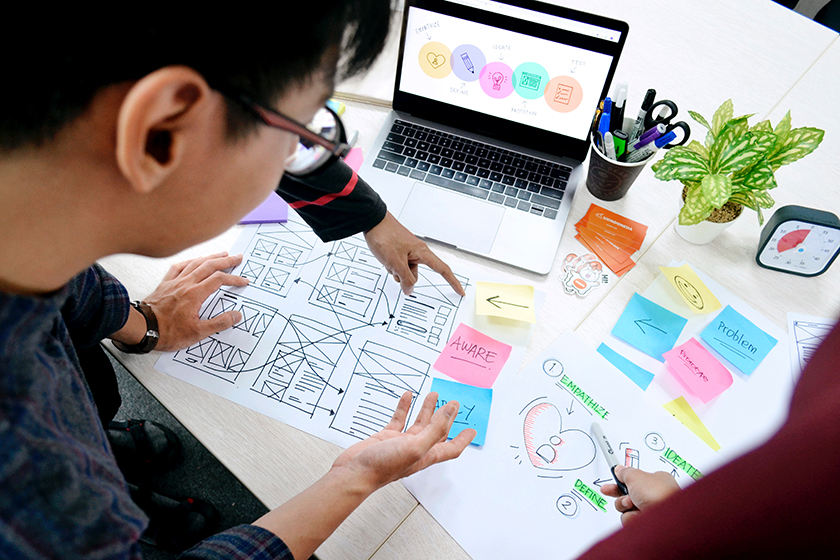
Nowadays, thinking of any brand representation in the digital environment without using the technique of design thinking is nearly impossible. That is because, since design thinking is a way to understand the users by focusing on problem-solving according to their needs, it is up to UX professionals to take advantage of this technique to conduct their projects. After all, the designer needs to develop what people need and not precisely what they say they need.
Even though people often think of design thinking as a concept analogous to UX design because they tend to coexist in the development of projects, they are, in fact, different.
Design thinking is a method for discovering and solving problems based on imagination, reasoning, and logic, with the intent of understanding the user’s frustrations and goals. In other words, UX uses design thinking as one of the techniques to understand and test all the points of contact with users aiming to provide a good experience with the product or service.
How does the process of design thinking work?
As previously mentioned, design thinking in the UX framework is a process focused on solving structured problems based on the end user. Thus, for a project to be successful, it is critical that the design team focuses on actually approaching and understanding the audience while working with critical development points. To achieve this goal, some key design thinking steps must be considered during the process. Let’s take a quick overview of each of them:
-
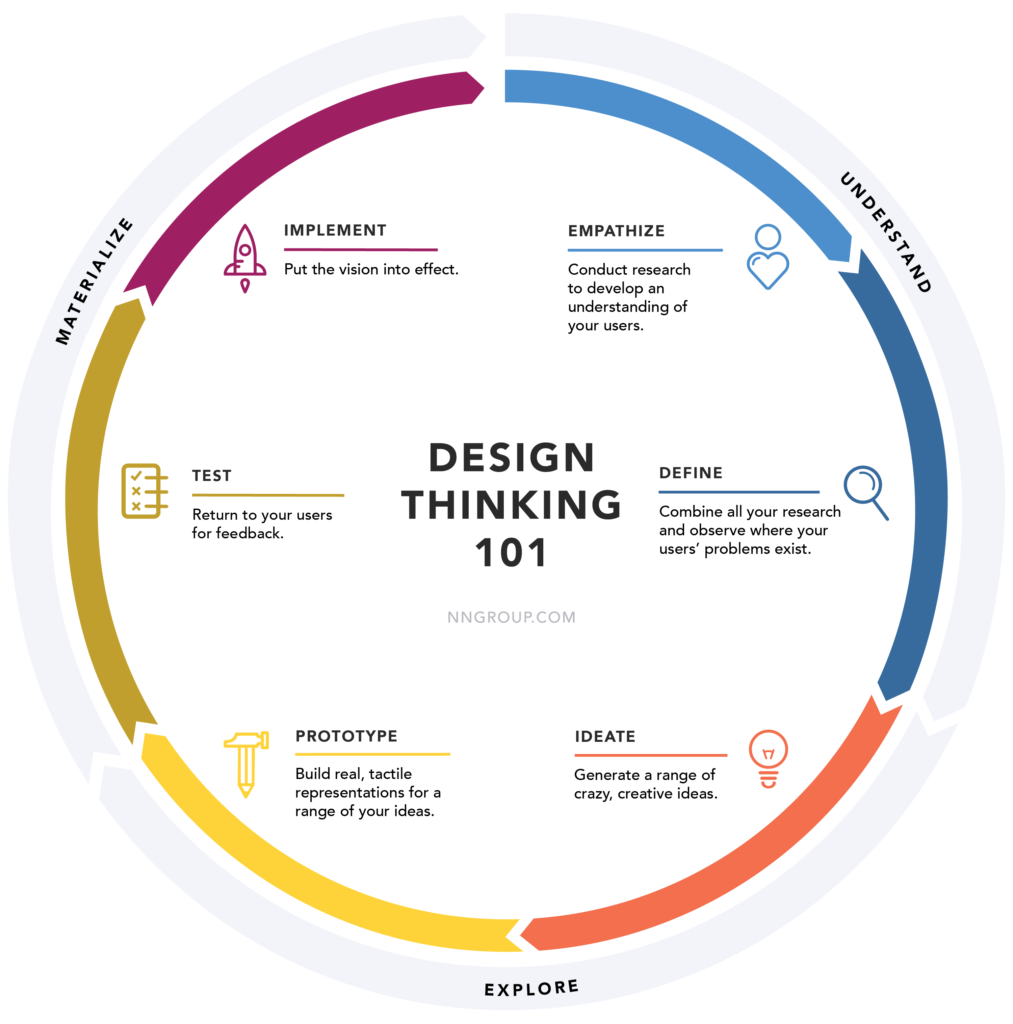
Empathize: this step is considered by most people as the most important of the methodology as it approaches understanding the users, their needs, attempting to grasp why they do certain things in a certain way and what the aspects involved in that behaviour, such as their emotions, desires, frustrations, wishes and pains.
Regardless that the concept of empathy is often interpreted as “imagining yourself in someone else’s shoes”, in design thinking applied to UX it is essential to know that the designer is not the user. Understanding how the user feels at this stage requires in-depth research as everyone has different ways of thinking. Thus, it is the designers’ role to recognize and respect the differences between themselves and the user to truly comprehend what the user needs and not mix it up with their own perceptions. Otherwise, the designer would come up with something that would not work for the client because it would not reflect the end user’s reality. In summary, this idea is far more about alterity than literal empathy.
-
Define: with the discoveries gathered in the empathize stage, the next step is to define the problem the designer must solve and, for that, it is necessary to synthesize all the collected data into insights and opportunities for the project. At this stage, the importance of having a well-defined problem statement stands out so the designer can direct and prioritize what needs to be addressed. Consequently, it is fundamental that the problem statements:
-
Present objective arguments but be broad enough to provide creative freedom;
-
Focus on the value and not the solution;
-
Always be human-centred and user-focused.
-
Always try to understand the user and define the problem well.
-
Ideation: Once the end user and the problem statement are well defined, at this stage, the ideas start to take life, requiring that as many solutions as necessary be explored and suggested. There are no limits to creativity because the objective of ideation is to consider the problem from several angles generating as many ideas as possible. To sharpen the creative spirit of those involved in the project, techniques such as brainstorming, mind mapping, word banking, or any other that the team suggests can be used.
-
Prototyping: Allows the comprehension of how the users will interact with the project in a way that is closer to a real scenario, besides aiding in the optimization of the solutions in a faster and more assertive way. Prototypes do not need to be a faithful representation of what the final product will look like; they can be made in, for example, hand-drawn interactive wireframes. The focus should be on identifying what idea works or not for the user.
-
Test: finally comes the moment to materialize all the ideas in a real scenario with users so that the designer can observe their impressions and get feedback. The key element is listening to what people think of the ideas proposed with the focus on applying improvements to the product’s ease of use and creating the solution that generates the most value for the client.
-
Implement: In the last stage of design thinking, it is time to take the solution to the public by testing it in the actual marketplace. Nevertheless, that does not mean that the product is flawless, as it may be the case that the designer realizes that, even with all the tests, there are still opportunities to be explored, which makes it necessary to revisit other stages of the design thinking process to adjust details.
As well illustrated in the representation below, design thinking is a cyclical process that allows reformulation and there is no mandatory order to reach the project’s objective.
In short, when moving forward with the design thinking process, remember that the priority is the user and that defining a well-structured problem statement will be the foundation for all the other phases. From the moment the project starts with a solid base, with a clear knowledge of the main goals, refining ideas later on and identifying opportunities for improvement will be much simpler.
References:
Gibbons, S. (2016, July 31). Design Thinking 101. Nielsen Norman Group. https://www.nngroup.com/articles/design-thinking/
If you enjoyed the content, stay tuned for the following posts, and if you want to get in touch with me or know more about my work, check out my Homepage and hit me up!
Leave a Reply