

UX Research is one of the many areas that comprise the vast world of UX and one of the most important in bringing a viable product or service to the market. This area is about researching various ways to understand problems and reduce the risk of creating bad designs due to a lack of information about the user.
In short, the three main goals of UX Research are to find out the right problem to be solved, the best solution, and the right way to solve it.
Do not forget that the UX designer is not the user. Therefore, the best way to understand the users’ needs is to ask them what they feel, think, need and want. The role of the UX designer is to understand the users’ goals and, based on this information, seek solutions that effectively meet such needs.
Research is essential at all design stages, as it is the only way to ensure the validation of the product at all levels of its development and to provide an overview of the numerous possibilities for data collection in research. The Nielsen Norman Group features on their site a cheat sheet created by Sarah Gibbons, that outlines research methods suggested for each phase of the project:
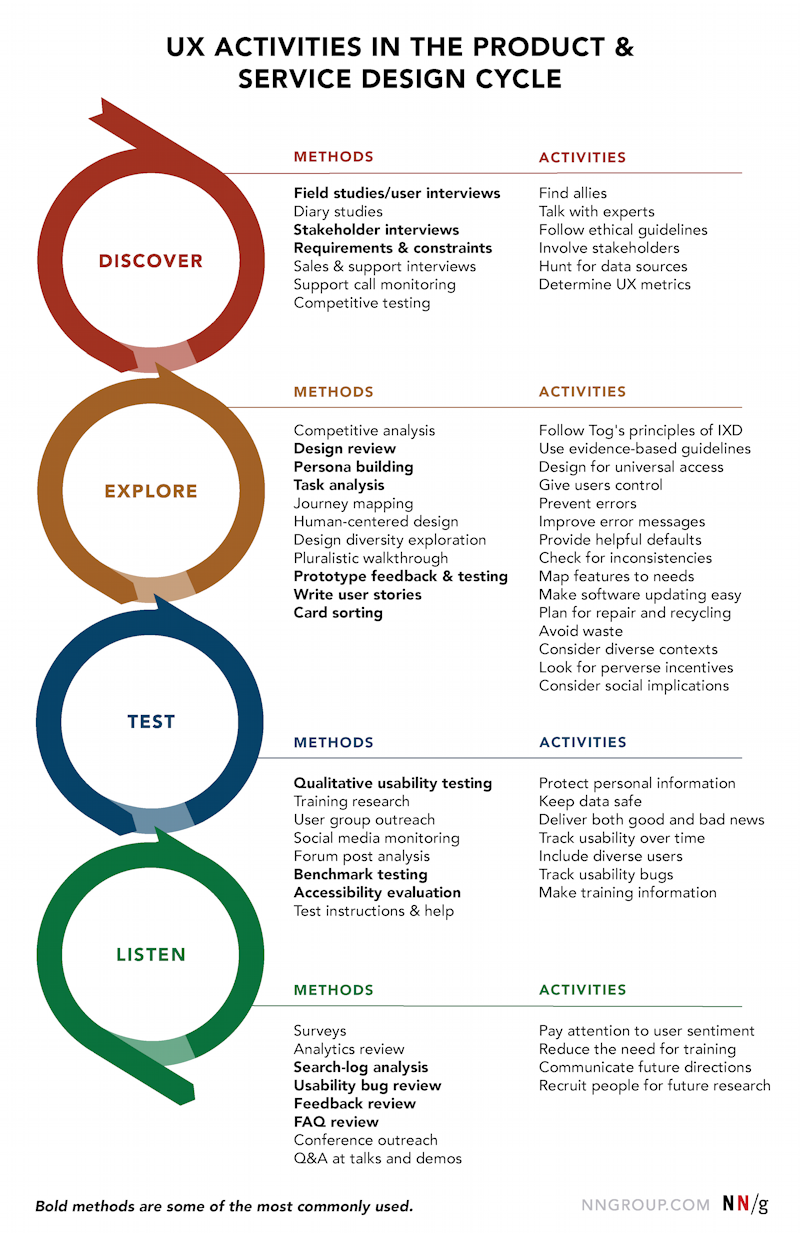
Understanding the key methods in each phase
Discover
As already touched upon in the previous post, the discovery stage aims to understand the user and the problem. However, under the premise of the total absence of this information, the types of research considered ideal for this step are:
- User interviews and field study: Researchers go directly to users to interview or observe them in their natural environment to understand their interaction with the theme to be developed, product or service.
- Stakeholder interviews: Interviewing stakeholders can be a determining factor for the success of a project since this method aims to understand the business objectives, key results, data and insights about business problems or even solutions that have already been implemented.
- Diary studies: Aiming to understand the user’s needs and behaviours, in this approach, the participants receive a diary or other device in which they record their daily interaction with the product.
Explore
It is time to understand the scope and dimension of the problem the designer aims to solve. After analyzing the results obtained in the first discovery stage, the next step is to find out if the user’s needs will be met adequately.
The most commonly used methods to get this input are:
- Design Review: It is essential to constantly review the design and apply changes that make sense for the user.
- Journey Mapping: This method visualizes the user interaction in all the touch points with a product or service. Mapping helps in the conception and improvement of interfaces since it focuses on the analysis of the user experience before, during and after performing an activity, which, among other things, enables the identification of risk areas for customer loss when interacting with the product.
- Feedback and prototype testing: It is necessary to test with groups of key users using low-fidelity prototypes (clickable or paper) to get feedback on where the problem areas of the project lie. Once the reviews are done, further tests are conducted until a viable result is obtained with the participating users.
- Card sorting: This method aims to identify how people group their information. By using cards or post-its, the participating users sort items according to what makes sense to them. Card sorting facilitates the creation of systems and platforms, making them more intuitive and user-centred.
- Persona: A persona represents the ideal user of the product or service. To understand how the project fits into the life of that persona, the researcher has to think about all characteristics, behaviour, what the persona seeks to solve and even how the solution is expected.
- Competitive analysis: Comparing the features and usability as a whole with those of competitors.
Test
In this stage, it is determined whether the findings and possible solutions to the problem are truly useful for the users, and there are several ways to perform this evaluation:
- Qualitative usability testing: Through tools such as screen-sharing software, Testing can occur remotely or in person. The purpose of this method is to collect metrics that describe the user experience, such as time to task completion and success in completing the task.
- Benchmark testing: Used to determine the execution time, task completion and bug rates of the current system by comparing these parameters with the competition.
- Accessibility evaluation: One of the most critical points in developing any digital product or service is accessibility. The researcher has to test the solution to ensure that it is accessible to all possible types of users. Most importantly, accessibility standards have become a legal requirement.
- A/B Testing: This test assesses the user’s preference for different versions of the same product.
Listen
One of the greatest skills that professionals in any field can develop is the ability to listen. In UX design it should not be different, for only by listening is it possible to understand problems, identify opportunities and find solutions that will benefit the client and user. Below are the most used methods for this practice:
- Survey: UX survey is a quick way to collect user information through forms. The data collected can be qualitative and quantitative, and the researcher must know how to ask the right questions to get the answers they are looking for.
- Search-log analysis: This analysis lies in understanding what users search for and usually provides relevant information that helps map out key usability issues. Thus, allowing for comments, questions, bug reports, and feedback help with the comprehension of the users’ needs.
- Usability bug review: Once more highlighting the importance of feedback in research, this approach seeks to identify what people cannot find and/or any unwanted results they might experience. It is also a way to track usability problems and problem areas of the product or service.
- Frequently-asked-questions (FAQ) review: This is a well-known tool since frequently asked questions indicate precisely the problem areas that need to be tackled. It is equally important to publicize that the problem has been solved so that other users can find the information they need as quickly as possible.
Needless to say, the methods applied in each stage will vary based on the complexity of the project and the knowledge already gathered by the team. Still, as UX professionals, it is imperative to solve a problem from a holistic perspective, avoiding easy solutions or putting ourselves in the user’s shoes.
Lastly, note that the research can also be categorized as quantitative or qualitative, but this subject will be explored in a future post.
References:
Farrel, S. (2017, February 12). UX Research Cheat Sheet. Nielsen Norman Group. https://www.nngroup.com/articles/ux-research-cheat-sheet/
Farrel, S. (2017, July 30). Search-Log Analysis: The Most Overlooked Opportunity in Web UX Research. Nielsen Norman Group. https://www.nngroup.com/articles/search-log-analysis/
Rohrer, C. (2022, July 17). When to Use Which User-Experience Research Methods. Nielsen Norman Group. https://www.nngroup.com/articles/which-ux-research-methods/
If you enjoyed the content, stay tuned for the following posts, and if you want to get in touch with me or know more about my work, check out my Homepage and hit me up!
Leave a Reply